CMHA Closes $34M Purchase of Hudson Crossing in Grove City
Columbus's housing authority has completed its $34 million purchase of Hudson Crossing, a 166-unit Grove City apartment complex it financed entirely with bonds.
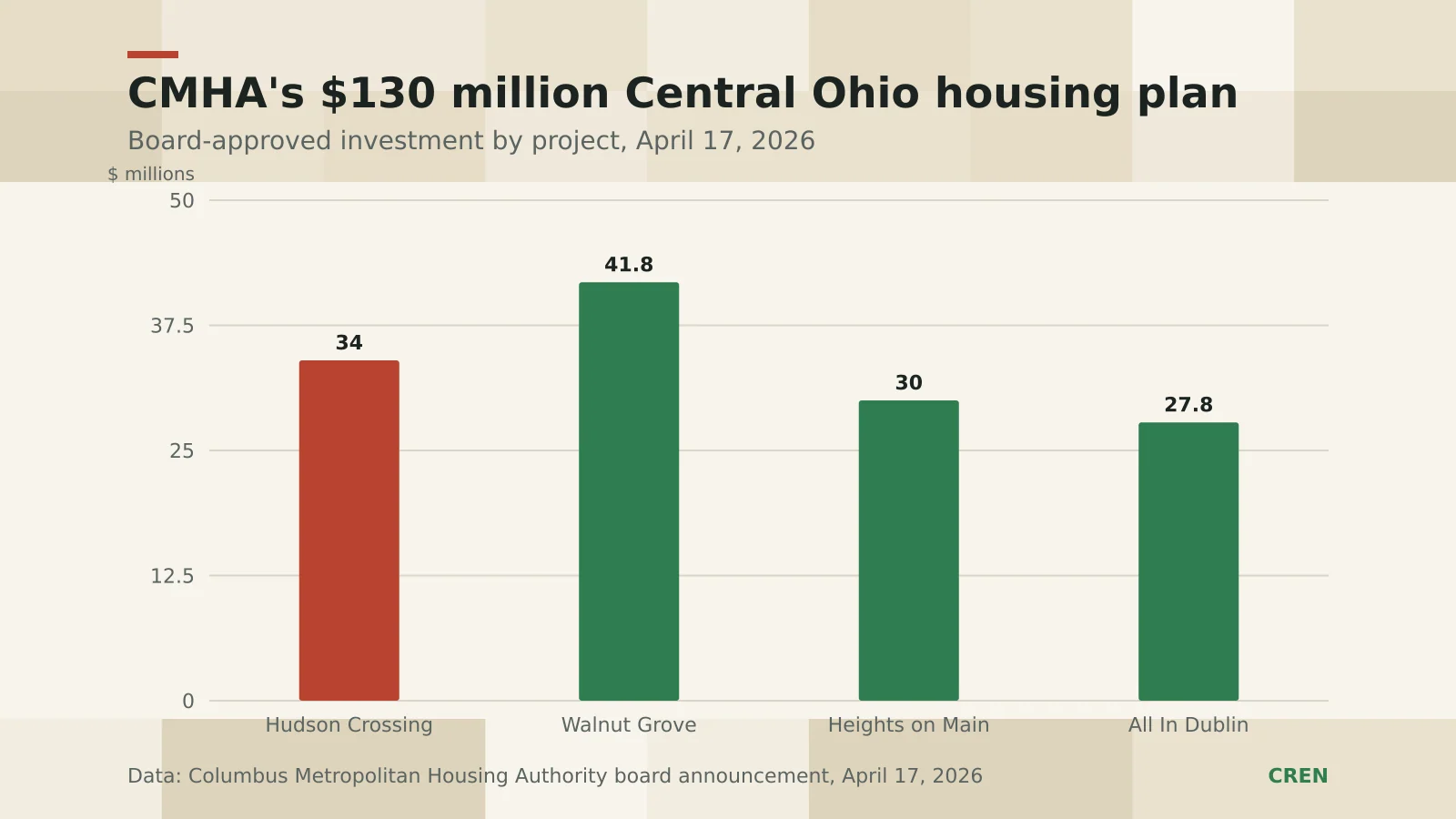
The Columbus Metropolitan Housing Authority has taken ownership of Hudson Crossing, a 166-unit apartment community in Grove City, completing a $34 million purchase its board approved in April. The agency financed the market-rate complex entirely with bonds and says the property is now nearly fully leased.
From spring approval to a fall closing
CMHA said on November 9 that it had taken ownership of the Demorest Road complex, describing it as nearly fully leased after about six months on the market. The deal itself was not new: the agency's board of commissioners approved the $34 million acquisition on April 17 as part of a package of investments totaling more than $130 million across Central Ohio. The gap between that April vote and the November closing is the difference between a plan and a done deal.
What CMHA is buying, and for whom
Hudson Crossing finished construction in 2025 and offers one- and two-bedroom apartments ranging from about 681 to 957 square feet, according to CMHA's board announcement. The agency says the units sit beside the Interstate 270 loop in the South-Western City School District, aimed at low- and middle-income workers who commute into Downtown Columbus. Chief Operating Officer Scott Scharlach called the purchase "more than just a transaction, it's a strategic investment in the region's housing supply."
CMHA is financing the purchase through bond issuance rather than federal subsidy, an approach it says lowers borrowing costs so it can hold rents down. Housing bonds are debt the authority sells to investors and repays over time; because the interest is tax-exempt, the borrowing is cheaper than a conventional loan. The purchase does not add newly built homes to the regional supply; instead it moves an existing, privately built complex under public ownership, which CMHA says lets it keep the apartments stable and attainable for working renters.
Cheaper to buy than to build
Buying an existing building came at a lower cost per apartment than putting up a new one. At $34 million for 166 apartments, the deal works out to roughly $205,000 per unit. By comparison, CMHA's first Grove City project, the 82-unit Cobblestone Manor senior community that opened in April, cost about $28.6 million, or roughly $349,000 per apartment, WOSU reported. On a per-unit basis, the acquisition cost about 41 percent less than building Cobblestone Manor new, though the two serve different residents and the figure does not account for the age or condition of the buildings.
A growing footprint in Grove City
The purchase deepens CMHA's push into Grove City, a fast-growing suburb southwest of Columbus. With Cobblestone Manor's 82 units and the 166 apartments on Demorest Road, the authority now holds roughly 248 units in the city, which WOSU reported already had 188 federally subsidized apartments. Buying a finished, nearly full building is also a faster way to secure homes than new construction, which can take years from groundbreaking to lease-up. CMHA framed the April package as money to acquire, develop and renovate more than 500 apartments region-wide, and the Demorest Road deal is the share aimed at preserving existing workforce housing rather than building new.
What the records do not yet show
Several questions remain open in the public record. CMHA has described the property as market-rate and aimed at low- and middle-income commuters, but it has not published the income limits or rent levels that will apply now that a public agency owns the building, so how affordable the units will be is unverified. Matter News reported in 2025 that CMHA's recent work is not heavily focused on households earning below 30 percent of area median income, a role largely left to nonprofits such as Homeport.
The Affordable Housing Alliance of Central Ohio counts only 29 available units for every 100 extremely low-income households in the region, a shortage this purchase does not directly close. CMHA's next scheduled step under the April plan is a $41.8 million renovation of the 176-unit Walnut Grove Apartments in Blacklick, which the agency said would begin in November.
Looking for a place to rent?
Tell us your budget and the areas you like. We send you Columbus rentals that fit what you can actually spend. Renters pay us nothing.
Find a rental