Columbus Ties a Proposed 18% Water Rate Increase to Growth
The Columbus water rate increase would rise 18% in 2027 inside a utility package tied to housing growth, alongside sewer and stormwater hikes and a November 23 City Council vote.
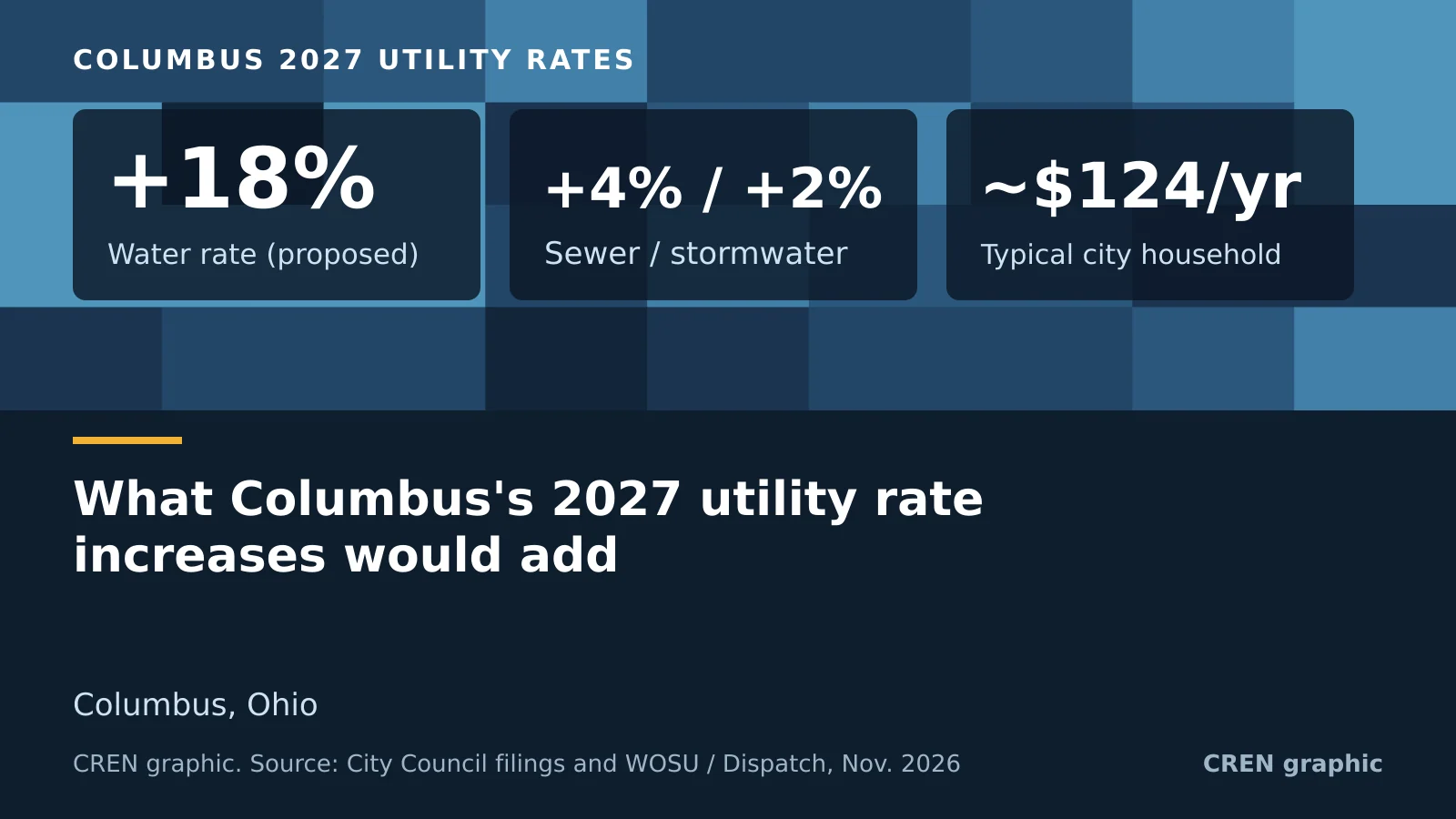
Columbus has introduced sewer, stormwater, and electric rate increases for 2027 and is weighing an 18% water increase that city utility officials link to the region's housing growth, with a City Council vote expected November 23. For a typical city household, the water and sewer changes would add about $124 a year.
What Columbus has put on the table
Columbus Water and Power, the city-owned utility, has asked City Council to raise four utility rates starting in 2027. Three of those increases are already moving as ordinances: a new sanitary sewer rate, a new stormwater fee, and a new electric rate, each introduced November 4, 2026 and each effective January 1, 2027. The 18% water increase that city officials have described publicly is the piece Council has not yet taken up as its own rate ordinance.
A CREN review of the Columbus City Council legislation portal on November 14, 2026 found the sewer, stormwater, and electric measures at first reading but no separate water rate ordinance among the filed 2027 rate items. The Columbus Dispatch reported November 12 that Council plans to vote on the rate increases November 23, 2026.
Why the city says rates must rise
According to WOSU, which detailed the plan November 13, the money would help pay for a new water treatment plant on Home Road in northwest Columbus that the city calls the most expensive project in its history. Columbus Water and Power puts the plant's cost at about $2 billion; the project drew no construction bids earlier this year, and the city aims to rebid it in early 2027 and open it around 2030, eventually treating up to 90 million gallons of water a day.
Deputy Water and Power Director Jon Lee tied the plant directly to growth, telling WOSU the investment is "essential to support continued housing development." The city also faces roughly $1 billion in costs to find and replace lead service lines under a federal mandate, a second driver behind the rate requests.
What it would mean for housing costs
The utility's own estimates, reported by the Dispatch, show a typical Columbus household of two to three people paying about $1,371 a year for water and sewer in 2027, up from $1,247, an increase of about $124, or roughly 10%. Suburban households on city systems would pay about $1,523, up from $1,370, an increase of about $153, or roughly 11%.
Because every renter and owner ultimately pays water and sewer costs, directly or through rent, the increases raise the baseline cost of operating housing across the city and its suburbs.
To cushion lower-income customers, the sewer and electric ordinances would widen the utility's income-qualified and senior discount, which the city plans to deepen from 30% to 35% of usage; enrollment rose about 36% over the past year to roughly 11,800 households.
CREN's own arithmetic underscores the trajectory: because the city sought the same 18% water increase a year ago, a water charge raised 18% in 2026 and again in 2027 would stand about 39% above its 2025 level.
Whether new development should help pay
One part of the package speaks directly to real estate. WSYX reported in October that the utility recommended changing its water capacity fees so that new customers help pay for planned infrastructure, including the Home Road plant, rather than shifting those costs onto existing ratepayers.
Capacity fees are the one-time charges a builder pays to connect a new home or building to the water and sewer system. The same report said the city also put forward a surcharge on about 426 high-demand commercial customers, billed at $1.62 for every hundred cubic feet above a threshold, though the Dispatch reported November 12 that the surcharge was pushed back a year for further notice and review.
The debate, and what is still unsettled
The increases are not a done deal. At an October meeting, two of the seven members of the city's Utility Advisory Board voted against the 18% water increase, while the board backed the 4% sewer and 2% stormwater increases; the board's votes are advisory only.
Board member Katie White, who directs the Central Ohio Area Agency on Aging, voted no and suggested waiting a year, saying the upgrades are coming "at the cost of residents." Council President Shannon Hardin has not committed to the increase, pointing to "rising housing costs" and higher grocery, insurance, and childcare bills, while Public Utilities Committee chair Christopher Wyche backs the plan, saying the city has to "make adult choices" about its infrastructure.
These figures and plans carry real limits. The water increase is still a proposal, not a filed ordinance; the Dispatch put the plant's cost at about $2 billion while WOSU cited $2.5 billion, so the final figure is unsettled; and Council, which has the final say, has not voted.
What to watch next
The next checkpoints are concrete. Council is expected to give the rate ordinances readings and then vote on the full package by November 23, 2026; watch whether the 18% water increase is introduced as its own ordinance before that vote, and whether the capacity-fee change that would move more of the growth bill onto new construction advances with it.
Have capital ready for Central Ohio real estate?
Tell us what you want your money doing and we will bring you Columbus opportunities that match. We only work in Central Ohio, and we tell you what does not fit.
Start the conversationThis is educational and is not an offer to sell or a solicitation to buy any security. We never promise returns.