Columbus Weighs $9.8M to Help Rehab Two Aging Homeport Complexes
Columbus City Council is set to authorize two housing development agreements committing a combined $9.8 million in future bond funds toward Homeport rehabs of the George's Creek and Pheasant Run apartment complexes.
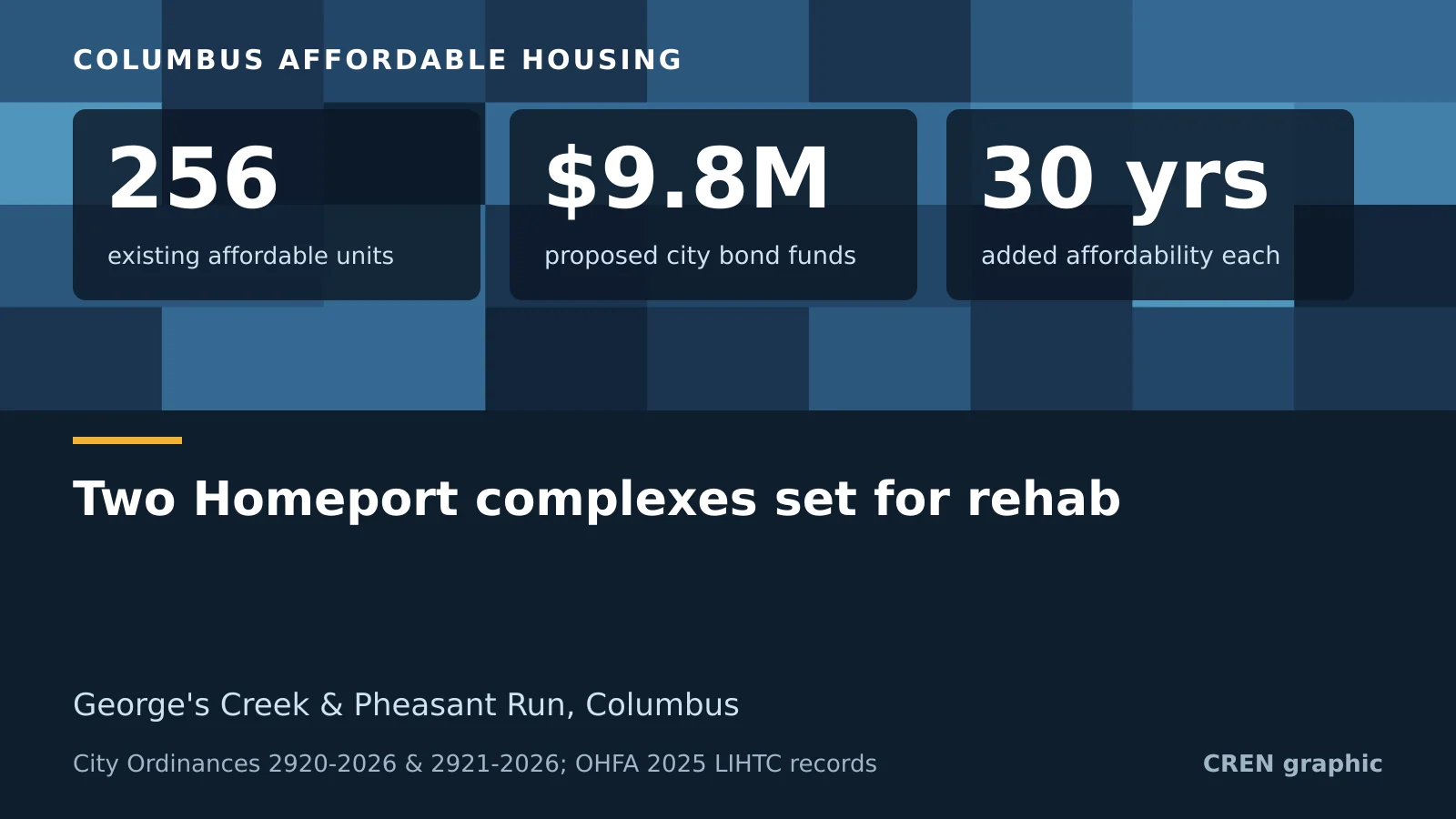
Columbus City Council is scheduled to authorize two housing development agreements on its November 2 consent agenda, committing a combined $9.8 million in future city Affordable Housing Bond funds to help the nonprofit Homeport rehabilitate two aging apartment complexes — the 120-unit George's Creek and the 136-unit Pheasant Run — and extend their affordability for another 30 years.
What the city would commit
The two measures, Ordinance 2920-2026 for George's Creek and Ordinance 2921-2026 for Pheasant Run, each authorize the city's development director to enter a housing development agreement, or HDA, with Columbus Housing Partnership Inc. Each ordinance lists a dollar amount of $0.00, a figure that understates the intent. An HDA records the city's planned funding so a project can close its financing, with the money itself authorized later in a separate grant agreement.
The George's Creek ordinance says the city intends to contribute $4.8 million, while the Pheasant Run ordinance puts its figure at $5 million. Both sums would come from the city's Affordable Housing Bond funds once those funds become available, with Homeport receiving the money as a pass-through entity. Added together, the two commitments total $9.8 million.
Two aging complexes, one nonprofit
Columbus Housing Partnership does business as Homeport, the central Ohio nonprofit that built both properties and still controls them. George's Creek, at 6300 George's Creek Drive on the city's southeast side, is a 120-unit family complex of 21 residential buildings on about 12 acres, finished in the mid-1990s and, by the developer's own account, not extensively renovated since.
Pheasant Run, at 2680 Orono Pike, sits on Columbus's far eastern edge in Fairfield County, where the state financing records carry a Reynoldsburg mailing address even as the city ordinance places the 13.98-acre site within Columbus. Developed in 1999 and 2000, it holds 136 units across 25 two-story buildings and has likewise gone without a major overhaul.
The timing is driven by expiring promises. Each property carries an affordability covenant, a legal cap that keeps rents reachable for lower-income tenants, and those covenants are set to lapse at George's Creek in 2029 and at Pheasant Run in April 2030. The ordinances say the rehabilitations would replace them with fresh 30-year covenants, and Pheasant Run's would restrict units to households earning no more than 60 percent of the area's median income.
How the financing stacks up
The city money is one layer in a larger stack. According to Homeport's 2025 financing applications to the Ohio Housing Finance Agency, the George's Creek rehabilitation carries an estimated total cost of about $35.5 million and Pheasant Run's about $42.5 million, each paired with a request for roughly $3 million in federal 4 percent low-income housing tax credits under the state's resyndication program.
That program lets the owner of an aging tax-credit property redo the deal to raise new repair money in exchange for extending affordability. The state financing, which includes tax-exempt bonds routed through OHFA, a state housing loan and the tax credits, is separate from the municipal Affordable Housing Bond dollars the city would add through the HDAs.
What CREN reported before, and what is new
The Ohio Housing Finance Agency board approved financing for the George's Creek rehabilitation on October 15, a state action CREN reported at the time. The November 2 vote is the city's own step, a formal commitment of local bond money that the earlier state approval did not cover. Pheasant Run, riding the same council agenda, had not previously appeared in CREN's coverage and did not share that October state approval; it is a second Homeport preservation deal moving on the same track.
The limits of today's vote
Passing the two ordinances moves no money. The HDAs commit the city only in principle, conditioned on the Affordable Housing Bond funds becoming available and on a later grant-agreement ordinance that Council would still have to pass. The dollar figures reflect the city's current intent, and the project costs are applicant estimates that can change before closing. The ordinances also say little about how tenants would be affected during the work, beyond George's Creek's note that it would proceed on a rolling basis to limit displacement.
What to watch next
The next verifiable checkpoints are the grant-agreement ordinances that would release the bond money, any OHFA bond-issuance and closing records, and City of Columbus building permits for the George's Creek and Pheasant Run addresses signaling that rehabilitation has begun. The George's Creek ordinance says renovations would start in 2026 and run about 24 months.
Looking for a place to rent?
Tell us your budget and the areas you like. We send you Columbus rentals that fit what you can actually spend. Renters pay us nothing.
Find a rental