Grove City Issue 28 Passes, Requiring a Public Vote on Big Projects
Grove City Issue 28, a citizen-led charter amendment, passed November 3, requiring a citywide public vote before the city can approve developments over 50 acres.
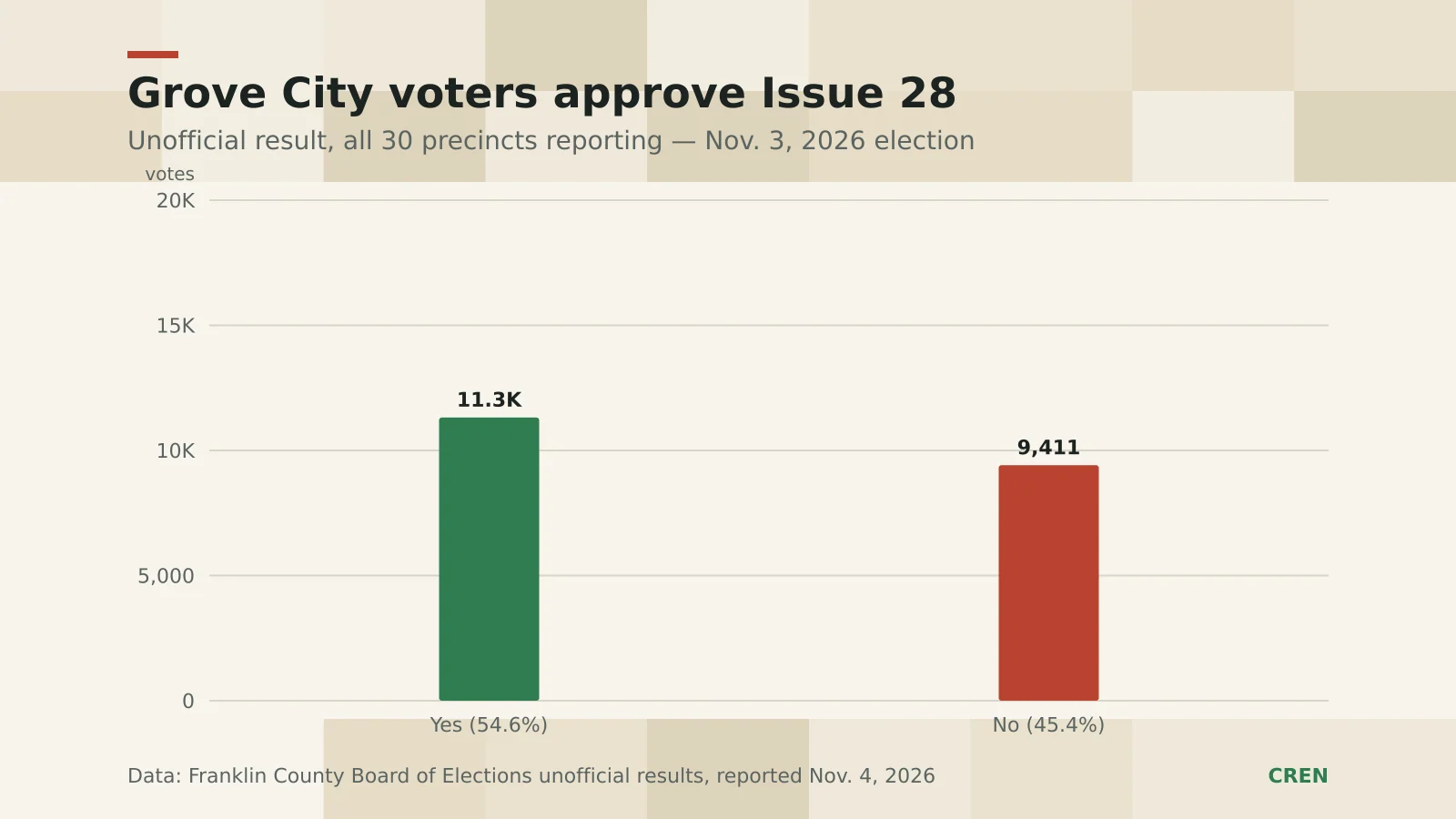
Grove City voters approved Issue 28 on November 3, a citizen-initiated charter amendment that now requires a citywide public vote before the city can approve any development of 50 or more acres, more than 20 megawatts of power, or more than 500,000 gallons of water a day. Unofficial Franklin County results show it passing 54.6 percent to 45.4 percent.
What voters decided
Unofficial results from the Franklin County Board of Elections show Issue 28 passing with 11,317 votes in favor and 9,411 against, a margin of 1,906 votes, with all 30 Grove City precincts reporting. The totals are not final; the Ohio Secretary of State says counties certify official results roughly three weeks after an election.
The board certified the measure for the ballot as a Grove City charter amendment that, in its official summary, "Creates a public referendum process for large developments." Because residents placed it on the ballot by petition, the language is written into the city charter, and council cannot repeal or rewrite it on its own.
The thresholds now written into the charter
Under the amendment's full text, a project counts as heavy industrial development, and must win a citywide vote before approval, if it occupies 50 or more contiguous acres, draws more than 20 megawatts of electrical power at peak capacity, or consumes more than 500,000 gallons of water a day. Meeting any one of the three limits is enough.
The text aggregates parcels under common ownership or a shared development agreement, counts every phase of a project together, and can pull in nearby land expected to be annexed, so a developer cannot stay under a limit by splitting a site. It also makes the developer fund the referendum election through a dedicated escrow account and pay for an independent impact study before any vote.
The data center campus behind the measure
The residents' group behind the amendment, Protect Grove City, organized against a proposed data center campus on Rensch Road. The group says the Texas developer Headwaters wants to build on roughly 310 acres there, about 98 acres of which have already been annexed into Grove City, with the rest still in neighboring Pleasant Township. WOSU reported that the plan calls for at least six server warehouses.
Karen Church, a Protect Grove City organizer, told WOSU that supporters are "extremely proud" of the result and cast the vote as one step toward giving residents a say over the largest projects. The amendment does not block the campus outright; it adds a public vote as a condition the project must clear.
What the city and business groups argued
Grove City's administration opposed the measure. On its official information page, the city estimated the amendment could add 9 to 18 months to a project's timeline and warned it could reduce the income-tax revenue that pays for emergency services, roads, and parks. The same page lists existing sites it says the thresholds could eventually capture, among them Mount Carmel Grove City hospital, several high schools, a Walmart distribution center, and Pinnacle Golf Club.
Grove City Council, the Jackson Township trustees, the Grove City Area Chamber of Commerce, and the Columbus Board of Realtors each formally opposed Issue 28. A campaign called Save Grove City, which WOSU reported was created by the Ohio Chamber of Commerce, argued the limits were too broad and could slow ordinary growth, not only data centers.
A broader Ohio pattern
WOSU reported that the Grove City result fits a wider trend this election of Ohio communities voting to restrain large data-center development, and noted that several places have moved to limit the industry. An earlier WOSU report had grouped Grove City with Trenton among Ohio communities weighing data-center measures on the same ballot. CREN detailed the amendment and the campaign around it in its Grove City coverage before the vote.
What happens next
The first checkpoint is certification: Franklin County's official canvass, expected in about three weeks, will confirm or adjust the unofficial margin. After the amendment takes effect, existing large facilities would have a 180-day window to file baseline declarations, a public filing that would show how many Grove City sites already sit at or above the thresholds. The harder test comes later, when a project first crosses a limit: whether Headwaters' Rensch Road campus becomes the first development sent to a citywide vote, and how the new charter language squares with Ohio's building and annexation laws if a developer challenges it.
Have capital ready for Central Ohio real estate?
Tell us what you want your money doing and we will bring you Columbus opportunities that match. We only work in Central Ohio, and we tell you what does not fit.
Start the conversationThis is educational and is not an offer to sell or a solicitation to buy any security. We never promise returns.