Columbus Bill Would Let Domestic-Violence Survivors Break Leases
Columbus City Council gives Ordinance 3350-2026 a first reading on November 23, a housing-code bill granting renters who document domestic violence a right to early lease termination without penalty.
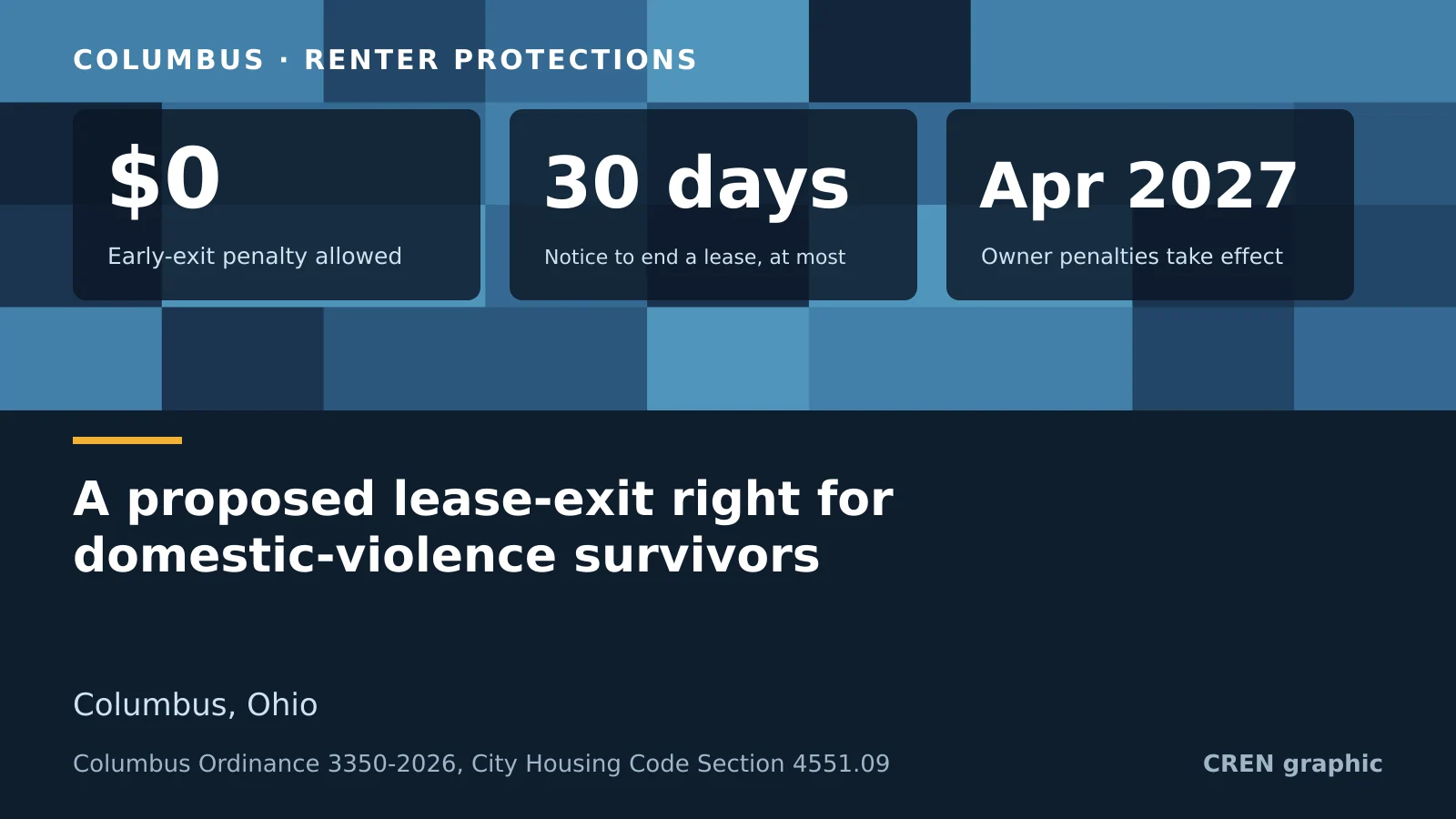
Columbus City Council will give a first reading on November 23 to Ordinance 3350-2026, a housing-code change that would let renters who document domestic violence end a lease early without penalty. Sponsored by Councilmember Tiara Ross, the bill adds new duties, and eventual criminal penalties, for rental owners.
What the bill would change
The measure adds Section 4551.09, "Family Safety and Protection," to Chapter 4551 of the Columbus City Housing Code, the standards the city enforces against rental operators. It lets a tenant who is an alleged victim of rape, attempted rape, domestic violence, dating violence, or a sexually oriented offense, or whose household member is a victim, end the lease or change the locks. A tenant qualifies in one of two ways: a court issues a protection order, or the tenant reports the crime to a qualified third party, such as a police officer, a health-care provider, a court employee, a mental-health professional, or a trained victim advocate, who signs a written record of that report.
The steps a renter and an owner must follow
To gain an early lease termination, the tenant gives the owner written notice and a move-out date no later than 30 days out, plus a certified protection order or the signed record of the report. The owner then has three business days to confirm the release in writing, and cannot charge an early-exit fee, pursue eviction for the early move, or withhold the security deposit beyond ordinary deductions. A tenant may instead stay and have the locks changed, and an owner who changes them may bill only the actual cost, capped at $150. The renter still owes rent through the move-out date.
Why the council says it is acting
The ordinance text ties the change to rising violence. It states that Columbus police logged 21,832 domestic-violence-related calls for service through August 2026, a 15 percent increase over the prior year, and that officials expect the annual count to pass 30,000. It also cites a wide housing gap, saying that 46 percent of Columbus renters are cost-burdened, spending more on housing than they can comfortably afford, compared with 8.4 percent of homeowners. The text calls Ohio one of only seven states without a specific law that lets survivors break a lease.
How it lines up with a stalled state bill
The city measure echoes House Bill 855, the Ohio Safe Homes Act, which state Representatives Melanie Miller and Michele Grim introduced on May 12, 2026, and which uses the same protection-order-or-advocate test. The two approaches differ on enforcement. The state bill would give landlords a tax credit when a tenant leaves early, while the Columbus ordinance would make several owner violations first-degree misdemeanors, with strict liability for failing to release a qualifying tenant. Columbus would hold off on any criminal enforcement until April 1, 2027, to allow a public-education period, and police could issue warnings until then.
What is settled and what is not
A first reading is not passage. The November 23 agenda lists the bill as item FR-34 in the Rules and Policy Committee, and council has recorded no vote, so a vote would come at a later meeting on the ordinary timeline because the measure carries no emergency clause. At an October hearing, Ross said, "No one should have to choose between their safety and their housing." The statistics and survivor testimony in the text are the council's own findings, which CREN has not independently audited, and the public file shows no formal response from landlord or property-owner groups.
What to watch next
The next checkpoint is the council meeting where Ordinance 3350-2026 returns for a vote, and whether members waive a second reading to act sooner than the standard schedule.
Looking for a place to rent?
Tell us your budget and the areas you like. We send you Columbus rentals that fit what you can actually spend. Renters pay us nothing.
Find a rental