Columbus Permitted 15 Homes Last Week, a Third Week Without Apartments
CREN tracked Columbus building permits issued November 9 to 15, 2026: 15 new homes, all single-family, and a third straight week with no new apartments as 2026 multifamily permitting runs about 27 percent behind 2025.
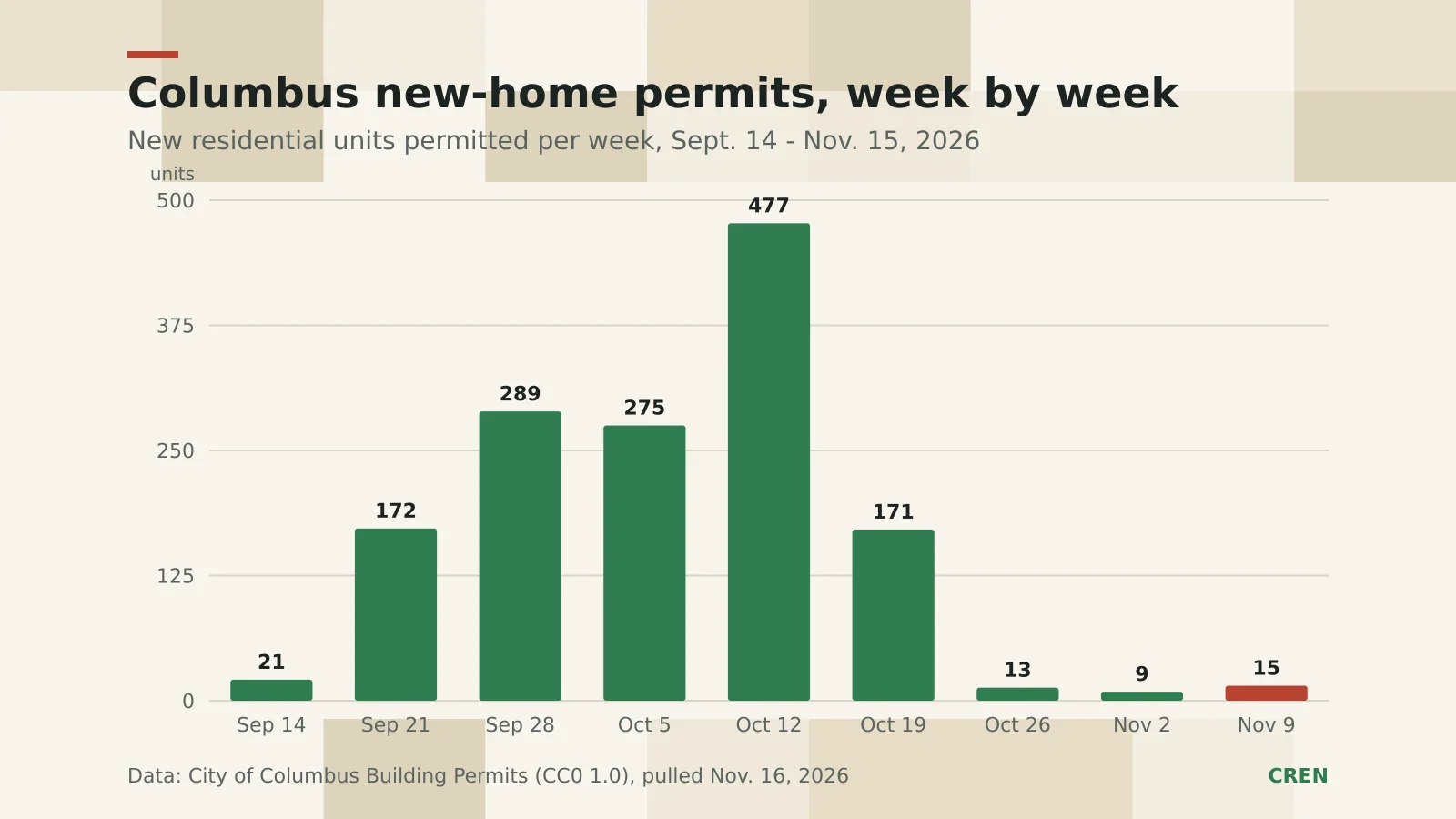
Columbus issued building permits for 15 new homes in the week of November 9 to 15, 2026, all single-family and up from nine the week before, but it approved no new apartments for the third straight week. Thirteen of the homes sat in one southeast-side ZIP code, and the week's single-family permits carried a combined declared value near $5.3 million.
How CREN counted the week
CREN queried the City of Columbus open building-permits dataset, which the city places in the public domain under a Creative Commons Zero waiver, through its ArcGIS feature service, for every new-structure permit the city issued from November 9 through 15, 2026.
The pull returned 17 permits: 16 for one-, two-, and three-family houses and one commercial permit that listed no dwellings. Fifteen of the 16 residential permits each recorded a single home; the 16th, on the far west side, listed no unit count and is not counted as a home here. No multifamily permit was issued. The figures reflect a November 16, 2026 pull, and the city updates the feed daily.
A third week without apartments
Fifteen homes is a step up from the nine CREN recorded a week earlier, but the count stays near the bottom of the autumn range because apartments have gone missing. The week of November 9 was the third straight week with no multifamily permit, after weeks that produced 13 and then nine homes.
Weekly totals swing hard because one apartment building can add hundreds of units at once. In the week of October 12 the city permitted 477 new residential units, its autumn peak, and the weeks of September 28 and October 5 cleared 289 and 275. Since the week of October 19, which still carried 152 apartment units, the multifamily column has been blank. The chart above tracks that fall from the October peak to the single- and low-double-digit weeks of late autumn.
Where the 15 homes are going
The homes clustered tightly. Thirteen of the 15 sat in the 43110 ZIP code on the southeast side, toward Canal Winchester, spread across three subdivisions: six on Testington Drive, four on Roandro Drive, and three on Marsh Pine Drive. Those 13 permits carried a combined declared value of about $4 million.
The two remaining houses were a $480,070 permit on Zucchina Drive in the 43026 code near Hilliard, on the far west side, and a $431,320 permit on Begonia Drive in the 43123 code toward Grove City. The lone commercial permit, a $142,685 structure on Citygate Drive in the northeast 43219 code near Easton, added no homes. ZIP codes cross municipal lines, so a code marks rough location, not which government issued a permit.
The yearly gap is an apartment gap
The steadier measure is the running annual total, and there the shortfall is almost entirely in apartments. Through November 15, Columbus has permitted 5,103 multifamily units in 2026 against 7,011 by the same date in 2025, a drop of about 27 percent. The year-to-date total across all new-structure housing stands at 5,864 units in 2026.
One caution on the year-over-year math. Between CREN's November 9 and November 16 pulls, the dataset's 2025 single-family total rose by about 310 units, nearly all of them stamped to the week of November 10, 2025 — a bulk backfill of older records, not new building. Because that revision lands entirely in last year's single-family column, a clean single-family year-over-year comparison is not possible this week, so CREN reports only the multifamily gap, which the same revision left untouched.
What the permit record does and does not show
These counts carry limits. A permit authorizes work but does not prove construction has started, so last week's permits are approvals on paper, not finished housing. One project can carry several permits, so a permit count is not a project count. Declared value is the applicant's own construction estimate, not a sale price or appraisal, and applicants enter the unit counts themselves, as the permit with no listed home shows. Because the city updates and revises the feed daily, a quiet week's total can still rise after this report, and earlier weeks can shift.
What to watch next
The next checkpoint is CREN's permit pull a week from now, which will show whether three thin weeks were a lull between apartment filings or the start of a slower winter. The open question is the multifamily column: whether a large building or two returns to the feed before year-end and narrows the gap against last year, or whether the blank weeks continue.
Have capital ready for Central Ohio real estate?
Tell us what you want your money doing and we will bring you Columbus opportunities that match. We only work in Central Ohio, and we tell you what does not fit.
Start the conversationThis is educational and is not an offer to sell or a solicitation to buy any security. We never promise returns.