Columbus Fair Market Rents Rise Nearly 12% for Fiscal 2027
HUD's FY2027 Fair Market Rents for Columbus rose about 12% by bedroom size, even as a separate rent tracker shows local asking rents nearly flat over the same year.
Columbus Fair Market Rents rose nearly 12 percent for fiscal year 2027, according to HUD's own published dataset, a federal benchmark that sets rent-assistance voucher limits across the seven-county metro. The increase took effect October 1, 2026, even as a separate rent tracker found Columbus-area asking rents essentially flat over the same year.
The figures come from HUD's Fair Market Rent dataset for fiscal year 2027, which the agency updates annually to set the maximum rent its Housing Choice Voucher program will help a tenant cover. The Columbus, OH HUD Metro FMR Area covers Franklin, Delaware, Fairfield, Licking, Madison, Morrow and Pickaway counties, which all share one published rent figure by bedroom count rather than separate county-by-county numbers.
What the new benchmark pays, by bedroom size
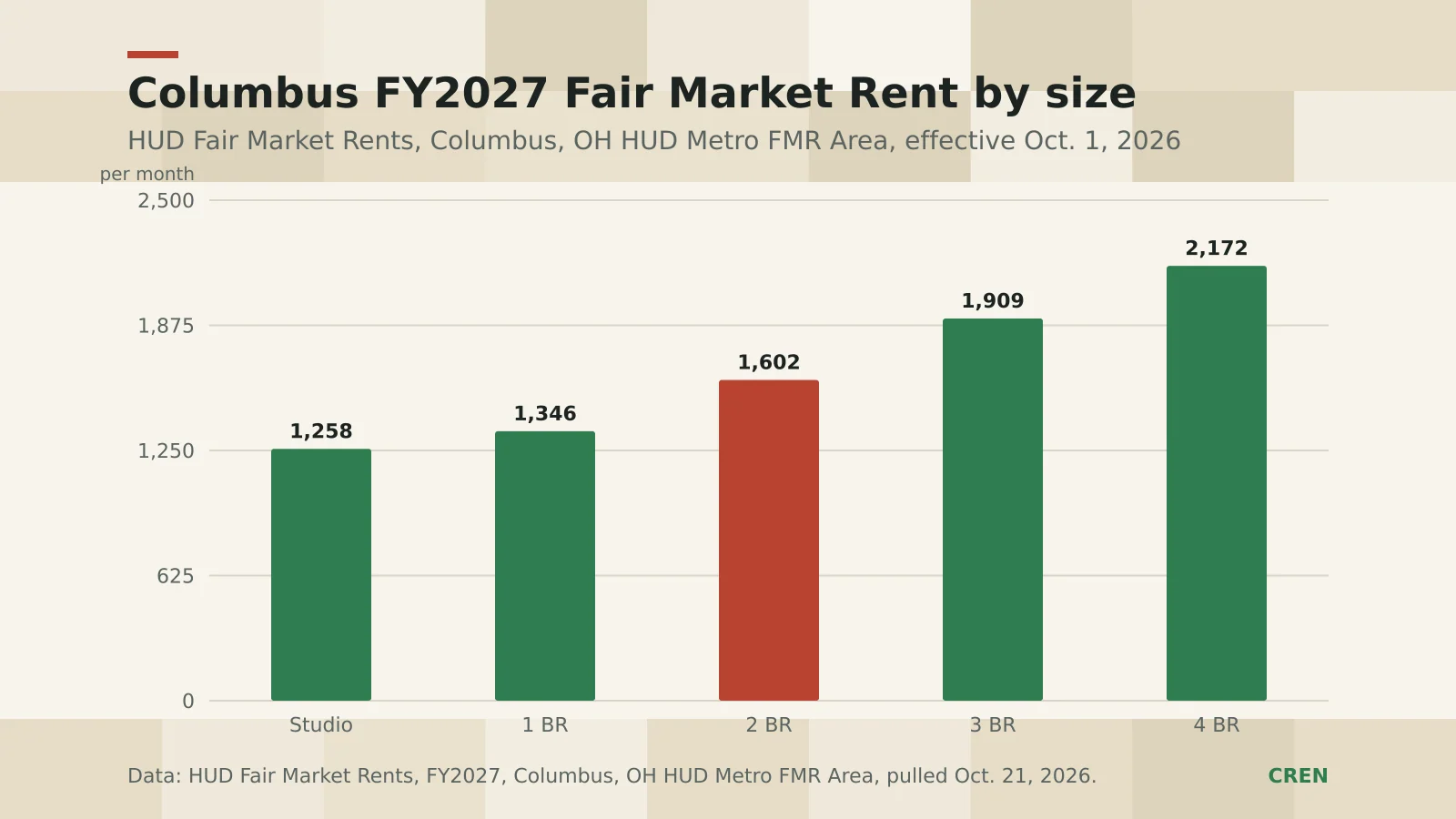
HUD's dataset lists five Fair Market Rent figures for the Columbus area for fiscal 2027: $1,258 for a studio, $1,346 for a one-bedroom unit, $1,602 for a two-bedroom unit, $1,909 for a three-bedroom unit and $2,172 for a four-bedroom unit, effective October 1, 2026.
Those figures are up from fiscal 2026, when HUD listed $1,111 for a studio, $1,194 for a one-bedroom, $1,430 for a two-bedroom, $1,715 for a three-bedroom and $1,927 for a four-bedroom unit in the same area, according to the agency's prior-year dataset.
That works out to year-over-year increases of about 13.2 percent for a studio, 12.7 percent for a one-bedroom, 12.0 percent for a two-bedroom, 11.3 percent for a three-bedroom and 12.7 percent for a four-bedroom unit.
A modeled government figure, not a snapshot of today's market
Fair Market Rent is not an average of current asking rents. HUD's Fiscal Year 2027 notice in the Federal Register describes a figure built from the 40th percentile of gross rent, meaning shelter rent plus a utility allowance, paid by recent movers into standard-quality units, not the rent every existing tenant already pays.
The notice says HUD starts with the Census Bureau's 5-year American Community Survey data covering 2020 through 2024 as the base rent for every area, then applies a recent-mover adjustment drawn from the 2024 single-year survey. From there, HUD trends that 2024 base forward to a 2025 value using a blended inflation factor, and the notice states that factor combines a measure built from six private rent trackers, one of them the Apartment List Rent Estimate, weighted at roughly 55 percent, with the Consumer Price Index measure of rent of primary residence weighted at roughly 45 percent.
A separate step the notice calls trend factor forecasts then projects that 2025 estimate forward again, to the fiscal 2027 period that began October 1, 2026, using local or regional forecast models built on Consumer Price Index rent data. The notice does not break out how much of the Columbus area's roughly 12 percent increase came from the 2024-to-2025 inflation step versus the later trend-factor projection, and it does not say whether Columbus had enough private-data coverage to receive a locally calculated inflation factor or relied on the regional Census-region average instead.
Apartment List helps build the figure it also appears to contradict
A separate, non-governmental measure points the other way over roughly the same period. Apartment List's October 2026 Columbus rent report put the metro's median rent across all bedroom sizes at $1,298 in September 2026, down 0.3 percent from a year earlier and down 0.6 percent from August.
That same company's rent estimate is one of the six private data sources HUD blends into the inflation factor described above, so the two figures are not fully independent of each other. But Apartment List's own published report reflects a live, same-unit read of current listings each month, while HUD's figure is one input averaged with five other private trackers and the Consumer Price Index, then carried forward through the multi-step calculation described above rather than published as a standalone local reading.
What the benchmark controls, and what CREN could not confirm
Fair Market Rent sets the ceiling for the Housing Choice Voucher program's payment standard, and federal rules let local public housing agencies set their own payment standard anywhere from 90 percent to 110 percent of that published figure. CREN could not independently confirm what payment standard the Columbus Metropolitan Housing Authority has adopted for fiscal 2027, since the agency's own site did not load from this environment during reporting, so renters who use a voucher should confirm their area's current standard directly with their local housing agency rather than relying on the published Fair Market Rent alone.
What to watch next
HUD's notice invites public housing agencies to request a reevaluation of a specific area's Fair Market Rent before it takes effect, a process this notice describes without listing a final Columbus-area deadline. HUD typically publishes the next fiscal year's Fair Market Rents in August, so the fiscal 2028 figures for Columbus would be the next checkpoint for whether this year's roughly 12 percent jump continues, levels off or reverses.
Looking for a place to rent?
Tell us your budget and the areas you like. We send you Columbus rentals that fit what you can actually spend. Renters pay us nothing.
Find a rental