Columbus Delays Its 2027 Utility Rate Vote, Citing Affordability
Columbus City Council skipped its expected November 23 vote on four 2027 utility rate increases, sending the water, sewer, stormwater and electric ordinances to committee after the council member who chairs utilities cited affordability.
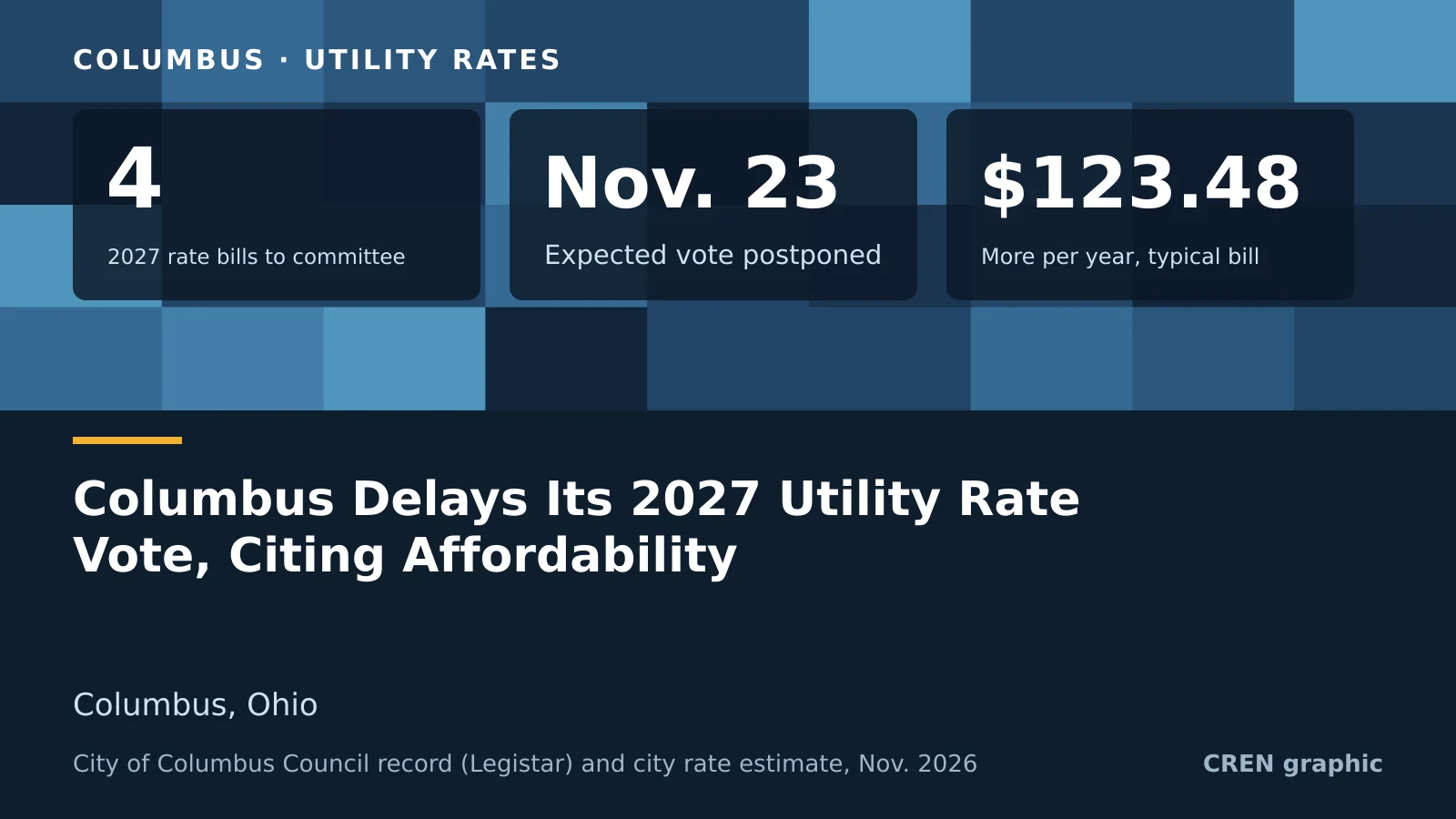
Columbus City Council did not hold its expected November 23 vote on four 2027 utility rate increases, instead referring the water, sewer, stormwater and electric ordinances to committee after the council member who chairs utilities said residents are struggling to absorb higher bills. The move leaves the proposed increases and their January 1 start date unresolved.
Council sends the rate bills to committee instead of voting
Columbus City Council was expected to take a final vote on November 23 on four ordinances setting 2027 rates for the city's water, sewer, stormwater and electric utilities. The council's own legislative record tells a different story. Each ordinance — 2027 water rates, sanitary sewer rates, stormwater rates and power rates — was read for the first time on November 16 and then "referred to committee" on November 23, with no adoption vote recorded. The city routes held legislation to its Rules and Policy Committee, and all four rate bills now sit there, their status listed as pending rather than passed.
Councilmember Christopher Wyche, who chairs the committee that handles utilities, said he was tabling the ordinances to give members more time to discuss the increases and look for ways to lower their effect on residents. "Each year it gets harder for our residents to take on the additional cost," Wyche said, as Columbus Navigator reported. NBC4 (WCMH), in an account carried by Yahoo News, reported the same postponement and quoted Wyche calling clean, safe drinking water "one of our most essential city services." Neither the council record nor the accessible reports set a date for the ordinances to return.
A word on terms: "tabled" is the shorthand the council member and local outlets used, while the city's legislative system records the formal step as a referral to committee. Both describe the same result — the expected vote did not happen, and the rates did not advance.
What the postponed increases would cost
CREN reported on November 14 that the package included a proposed 18% increase to the city's water rate, alongside new sewer, stormwater and electric rates, each introduced November 4 and each meant to take effect January 1, 2027. After the postponement, NBC4 described the water increase as about 10% and the Columbus power increase as about 13.5%.
The two water figures measure different things. The 18% applies to the water rate itself, while the roughly 10% tracks the change to a typical household's combined water, sewer and stormwater bill — an estimated $10.29 more a month, or $123.48 a year, a figure both NBC4 and Columbus Navigator reported. Columbus Navigator put the separate electric increase at between $7.86 and $11.90 a month, depending on a customer's rate class. The accessible post-vote reports do not publish the full rate tables, so CREN cannot reconcile every percentage to the dollar from the record in hand.
The water ordinance carries two features beyond the base rate. Its official title would create a new high-demand water surcharge aimed at the largest commercial users, and would expand the city's income-qualified and senior customer discount program. Local outlets described that discount as deepening from 30% to 35% of usage.
Why a utility vote is a housing story
Water, sewer and stormwater charges are a fixed cost of occupying housing in Columbus. Every renter and owner pays them, directly or folded into rent, so a change to the 2027 rates moves the baseline cost of operating a home or an apartment building across the city and the suburbs on its systems. Postponing the vote leaves that 2027 cost, and its January 1 start date, unsettled for landlords setting rents and for households planning next year's budget.
The requests trace back to large capital needs. As WOSU reported on November 13, the city says the new revenue would help pay for a roughly $2 billion water treatment plant on Home Road in northwest Columbus — which it calls the most expensive project in its history and ties to continued housing growth — and for about $1 billion to find and replace lead service lines under a federal mandate. Delaying the increases does not change those obligations; it changes when, and how, the city asks ratepayers to cover them.
What is still unresolved
The council record does not say when the ordinances will come back, and the accessible reports do not detail the specific revisions Wyche wants. The city's legislative record shows the referral passing but lists no roll-call vote tally for it, so how each council member stood on the postponement is not on the public record. With the proposed January 1, 2027 effective date now in question, the next verifiable checkpoint is a future Council agenda or Rules and Policy Committee meeting carrying revised 2027 rate ordinances — or the current ones brought back for a vote.
Have capital ready for Central Ohio real estate?
Tell us what you want your money doing and we will bring you Columbus opportunities that match. We only work in Central Ohio, and we tell you what does not fit.
Start the conversationThis is educational and is not an offer to sell or a solicitation to buy any security. We never promise returns.